Modulation / Function Generator

Behringer Abacus Review: High-Function Analog Utility on a Budget

Buchla-style dual function generation, sum/OR/difference logic and slewing, for the price of a single boutique utility.

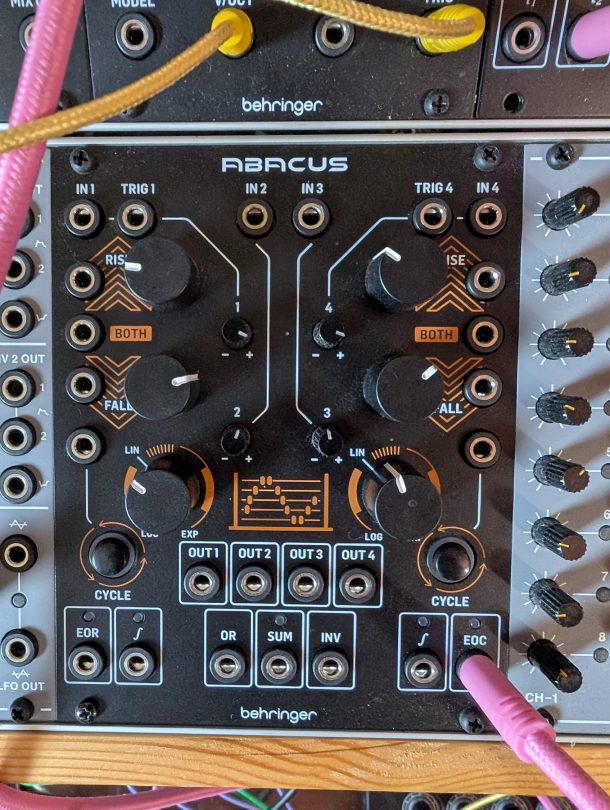
Behringer Abacus Eurorack module patched with cables in a rack, showing rise, fall, cycle, output and logic jacks
The Abacus patched up in the review rack.

The Abacus is a Buchla-inspired dual function generator — the analog-computer approach to modulation, where a channel is a voltage that rises and falls and can be patched into anything, including the other channel. It is the classic slope-generator concept, and it is the most affordable way into it.

Two channels, one analog computer

Each channel has rise and fall controls, an output, and gate inputs for trigger and cycle. Because the fall stage can be modulated externally, a channel can be made to behave like an envelope, an LFO, a slew limiter, or a pulse generator depending on how you patch it. The sum, OR and difference outputs let the two channels combine mathematically, which is where the module stops being “two envelopes” and starts being a small patch-programmable system.

The bouncing-ball patch

Patch Channel 1’s End of Rise to Channel 4’s trigger input and route Channel 4 back to modulate Channel 1’s fall. Each cycle shortens the next, so a single gate produces a repeated, decaying series of blips — the classic bouncing-ball envelope. It is the fastest demonstration that this is a different kind of module.

Where it compromises

The panel is 20 HP, which is a lot to commit for a utility. And the potentiometers feel lighter than the boutique equivalents — they are perfectly usable and track fine, but they do not have the damped, detented weight of a high-end build. At this price that is the trade, and it is a fair one.

The Abacus is two independent slew-based function generators built the analog-computer way: each channel is a voltage that rises and falls, and nothing about it is digital. What makes it more than two envelopes is how the stages are exposed.

  • Rise and fall are the two controls per channel, and a trigger or gate input starts the rise.
  • End of rise emits a pulse when the channel reaches the top, which is the feature that lets one channel drive another.
  • The fall stage is voltage-controllable, so its timing can be modulated from outside the channel.
  • Sum, OR and difference outputs combine both channels as voltages rather than as events, which is what turns two envelopes into a small patch-programmable system.

There are no menus and no modes: every behaviour is a function of what you patch.

Patch recipe

Bouncing Ball Envelope: Patch Channel 1 EOR (End of Rise) to Channel 4 Trigger In, modulate Channel 1 Fall via Channel 4 Unity Out.

The Verdict

8/10

An accessible entry point into Buchla-style dual function generators. It delivers all the core logic, envelope, and slewing duties expected of an analog computer at a fraction of the traditional cost.

Pros

  • Extremely affordable per-HP function generator
  • Very shallow 24mm depth fits any skiff
  • Full analog sum/or/difference math logic

Cons

  • Wide 20HP panel footprint
  • Potentiometers feel lighter than boutique hardware

Does it stay in my rack?

Stays in the rack

Abacus stays in the rack. Nothing else in the system does end-of-rise logic, voltage-controlled slew and analog sum/OR/difference maths, and those are the operations that glue otherwise unrelated parts of a patch together. Even in a patch where it is not making a sound it is usually doing timing or logic work somewhere. Twenty HP is a real cost, but it is a permanent fixture in the same way power is.

The Clone Question

I like this module a great deal. It is the cheapest way into this whole branch of synthesis, it does everything it claims to do, and it has not left my rack since the day it went in — which is about the most honest recommendation I can give a piece of gear.

Where it becomes uncomfortable is provenance. The Abacus is a copy of Make Noise Maths, and Maths is not a long-gone classic nobody can buy any more: it is a current product from a small company that is still building and selling it. That distinction is the whole argument. Reissuing an unobtainable design is one thing. Reproducing a module its original maker is still shipping takes sales away from the people who did the design work, and that is not a detail to wave off because the price is good.

What disappoints me more than the copying is the missed opportunity. Several current modules cover roughly these capabilities, and each solves part of the problem differently — another way of exposing the ends of a stage, another approach to cycling, different panel logic, a different feel under the fingers. Behringer has the manufacturing scale to take the best idea from each of those and build something genuinely new. Instead it reproduced one design, and the result is a good, cheap module that could have been a good, cheap and original one.

None of that changes what the Abacus does or how it feels to use, and it stays in my rack either way. It is perfectly possible to recommend something and still wish it existed in a different form. Both of those are true here, and I would rather say so than pretend only one of them is.

Where to buy

Behringer Abacus

€99 / $109

Buy the Behringer Abacus

We may earn a small affiliate commission at no extra cost to you.