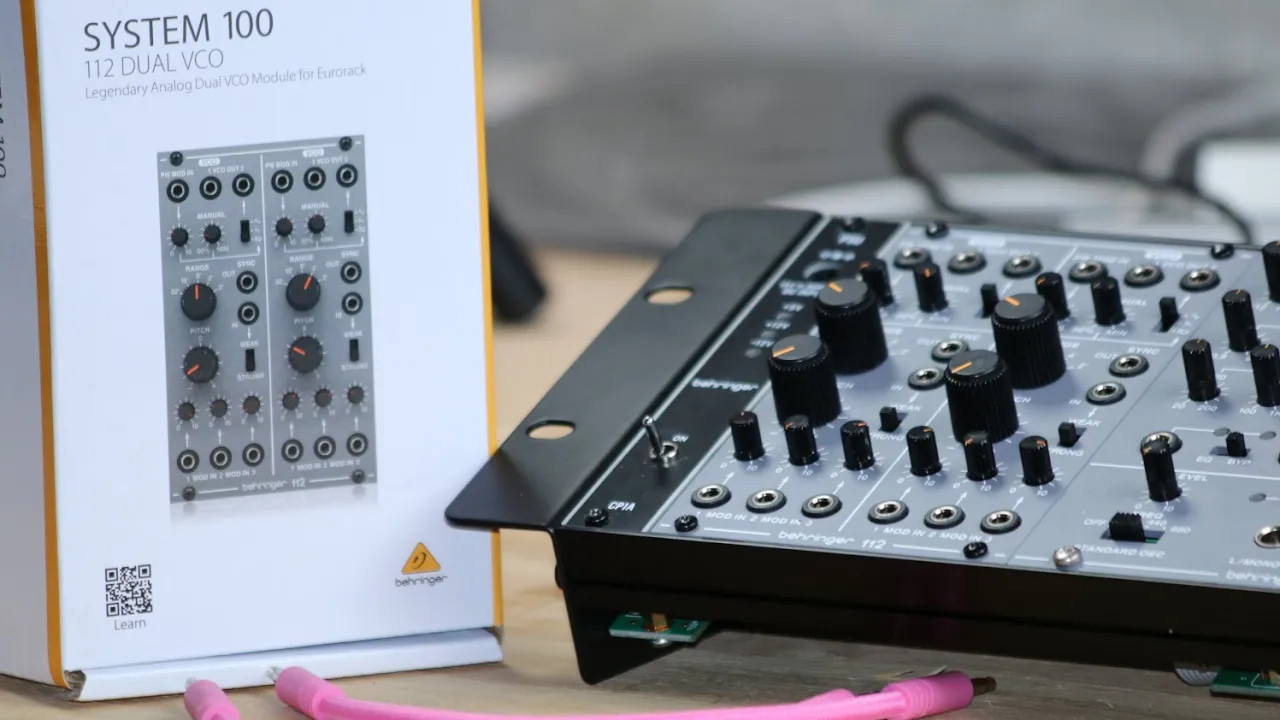
The 112 is Behringer’s reproduction of one of the founding modules of the Roland System 100M, the modular system Roland launched in 1979: two identical analogue oscillators in 16 HP, at a price (around €56) that barely covers the case space it occupies. It was the module I started my rack with, and this review is written from that history. It has since left my rack, and explaining why is not a criticism of it. I also filmed the unboxing and a first run of sounds, so you can hear the pair before reading on.
Two identical oscillators, and why that is the point
Each half of the panel is the same VCO: a waveform switch giving triangle, sawtooth and pulse, a manual pulse width control with its own PW MOD IN so the pulse can be narrowed by voltage while you shape it by hand, a RANGE switch stepping from 32′ down to 2′, and a PITCH knob that trims plus or minus one octave around the range setting. Pitch modulation arrives through summed control inputs at 1 V/octave: Behringer specifies three CV inputs per VCO, so an envelope and two LFOs can all push the pitch at once, with an input level control to keep the depth honest.
Sync is the lesson this module teaches best
Each VCO carries its own SYNC IN and SYNC OUT, and a WEAK/STRONG switch selects between the two behaviours: strong sync locks the follower hard to the driver for the classic aggressive bark, while weak sync pulls at the pitch without fully capturing it, which is where the sweeter, more string-like character lives. Having a sync output as well as an input means the pair can hand synchronisation onwards or lock to the rest of the rack. Ian Boddy, who played the original system, praised the 100M’s oscillator sync sound, and the same behaviour is what you get here.
What you give up
There is no sine wave: pulse, saw and triangle are the whole menu, and only the pulse can be width-modulated. The PITCH control spans a single octave either way, so bigger jumps ride the RANGE switch rather than a knob. The 46 mm depth rules out the slimmest skiffs, and the current draw, 90 mA on +12 V and 70 mA on -12 V, comes from the maker’s published specifications rather than our busboard meter, so check it against a power-tight case. Availability swings too: stock comes and goes, and at the time of writing Thomann expects the next batch in six to eight weeks.
Who it is still for
If you are starting a rack, this is the cheapest serious on-ramp into analog pitch: two well-behaved oscillators that respond exactly the way the textbooks say, for less than the cost of much of what surrounds them. If your rack already runs three or four oscillators with finer trim, deeper modulation and wave-shaping, the 112 has little left to teach you, which is precisely the position I ended up in.
Behringer describes the 112 as an authentic reproduction of the original System 100M circuitry, and the panel behaves the way that claim suggests: everything is a knob or a switch, and nothing is menued. Each VCO runs the same signal path.
- Waveform is a three-position switch: triangle, sawtooth or pulse. Only the pulse responds to width control.
- Pulse width is set by the manual control and shifted by voltage at PW MOD IN, which Behringer specifies at up to plus or minus 10 V with 4 per cent of width change per volt, so an envelope or LFO there animates the timbre while the knob sets the resting width.
- Pitch comes from the RANGE switch (32', 16', 8', 4', 2') plus a one-octave trim knob, and from summed control inputs at 1 V/octave across a 10 V range, each with its own level attenuator.
- Sync is per oscillator, with an input, an output and the WEAK/STRONG mode switch; the sync input triggers from 2.5 V peak-to-peak upwards.
The numbers behind the panel: outputs sit at 10 V peak-to-peak, the oscillators free-run from 10 Hz to 500 Hz and reach from 1 Hz to 30 kHz with external CV, and power arrives on a standard 10-pin Eurorack header, drawing 90 mA on +12 V and 70 mA on -12 V with nothing taken from +5 V. Physicals are 16 HP wide and 46 mm deep. All figures are the maker's published specifications.