Effects / DSP

After Later Audio Monsoon Review: Hands-On Granular Textures

A 12 HP reimagining of the Clouds concept where dedicated faders turn a menu-divey granular processor into an expressive instrument.

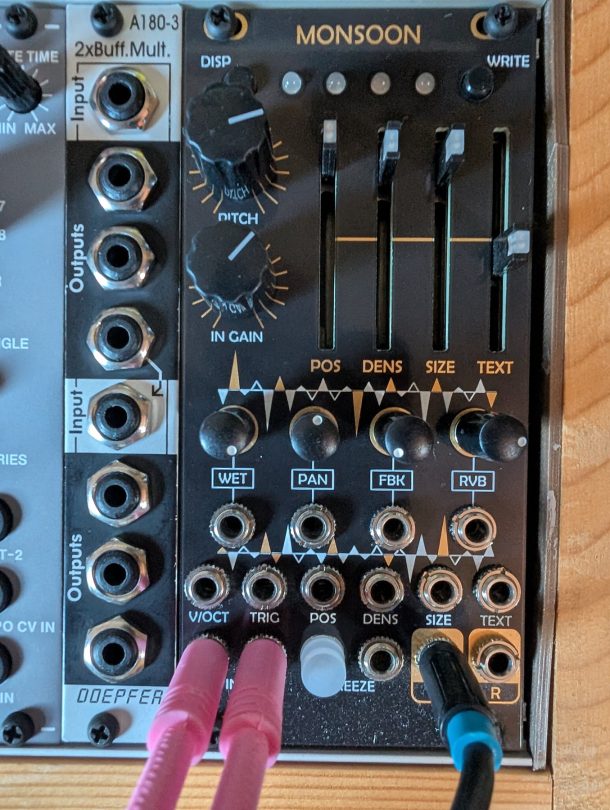
After Later Audio Monsoon Eurorack granular module patched in a rack, showing position, density, size and texture sliders with wet, pan, feedback and reverb controls
The Monsoon patched up: sliders for the granular parameters, dedicated controls for wet, pan, feedback and reverb.

The Monsoon is After Later Audio’s re-layout of the Mutable Instruments Clouds concept in 12 HP, and the change that matters is not the size: it is the faders. Where the original made you hold a button and turn an encoder to move through parameters, the Monsoon puts Blend, Feedback, Reverb and Pan on dedicated sliders.

Granular texture you can actually perform

That single ergonomic decision changes the module from something you configure into something you play. Sweeping the Feedback fader while the Reverb slider sits high gets you from a short grain cloud to an endless smear without ever leaving the panel. The Blend slider gives you continuous control over the dry/granular relationship, which is where the module’s most musical behaviour lives.

In practice

Feed it a decaying pluck and raise Density towards noon: the buffer fills with overlapping grains and the texture thickens without turning into noise. Reduce the grain size and the same input becomes a shimmer. The freeze function holds whatever is in the buffer, which is the most immediate way to turn a single note into a pad you can then pitch around.

Firmware

The Monsoon runs the standard Clouds firmware and the widely used Parasites alternative. We tested both; the alternate firmware adds modes that are genuinely useful and the module handled them without instability.

What you give up

Slider travel is short, so fine adjustments demand a light touch: the difference between a subtle change and a large one is a few millimetres. And once every jack is patched, the panel gets dense, which is the inevitable consequence of fitting this much into 12 HP.

Strip away the interface and the Monsoon is a granular processor in the Clouds lineage: audio is written continuously into a circular buffer, and grains are read back out of it at a variable position, size and density. The four faders map onto the stages you actually reach for while playing.

  • Blend crossfades between the incoming signal and the granular output, which is the control most of the playing happens on.
  • Feedback re-injects that output back into the buffer, which is what turns a short grain cloud into an endless smear.
  • Reverb and Pan sit at the end of the chain, after the granular stage rather than inside it.
  • Freeze stops writing to the buffer, which is why it can hold a single note indefinitely and let you pitch it around.

The DSP is the same engine the original Clouds runs, so the difference between the two modules is layout rather than sound, and both the standard and Parasites firmwares load onto this hardware.

Parasites deserves more than a passing mention, because it changes what the module is. It is an alternative firmware for Clouds written by Matthias Puech, built on the code Mutable published, and it keeps every mode the official firmware has (the granular one included, tweaked and extended) while adding two the stock module does not have at all. The first is Miverb: a full-featured, CV-controllable reverb with a mode of its own, built on the structure of the original reverb but going a long way past it, with pre-delay, room size, decay that reaches self-oscillation, pitch shifting and dampening. The second is Resonestor, a polyphonic resonator with Karplus-Strong built in, which turns a trigger or a plucked sound into strings, chords and evolving drones. There are looping delay and pitch-shifter modes alongside them. During playback the mode is switched by holding both black buttons until the LEDs blink, then stepping through with Blend or Load/Save. Clumsy, but a handful of menus, not a screen.

Installation is the same audio-file procedure the official Clouds manual documents, so no programmer is involved: download the firmware, play it to the module, follow the manual. Two practical cautions. Budget the recalibration that every firmware update requires, and read the warnings on the Parasites page before flashing: units sold before July 2015 needed at least firmware 1.3 to update safely, and there are documented cases of Clouds being bricked by an update. Parasites is a real upgrade to the module, but it is not a zero-risk one.

Patch recipe

Endless Ambient Reverb Pad: Send a pluck into In L, Freeze high, set Density to 12 o'clock, Pitch up +12 semitones, and max the Reverb slider.

The Verdict

6/10

A massive ergonomic upgrade over the original Clouds layout. The dedicated sliders for Blend, Feedback, Reverb, and Pan turn a menu-divey algorithm into an expressive performance instrument.

Pros

  • Dedicated faders for all 4 blend parameters
  • Compact 12HP skiff-friendly footprint
  • Runs standard and Parasites firmware smoothly

Cons

  • Slider travel is short
  • Dense patch point layout when fully cabled

Does it stay in my rack?

In and out as needed

Monsoon moves in and out as needed. It is not a module the rack has to have to function: when a patch wants granular texturing or a frozen pad it earns its 12 HP, and when the music is doing something else it comes out and the space goes to whatever the current patch needs. Skiff-friendly depth means it goes back in without a rebuild, which is the whole reason it rotates rather than staying put.

Not for Me, and Not the Module to Blame

Let me be clear about what this is not: it is not a criticism of the Monsoon. After Later Audio has done what a re-layout of Clouds should do: the ergonomics are better than the original in every way that matters, and the module does everything it claims to. The problem is me. I have owned this long enough to know that granular processing, and the Clouds approach to it in particular, is not how I want to work.

So why is it still in the rack? The Parasites firmware, and specifically the reverb it adds. Miverb is the mode I actually use, and in it the Monsoon stops being a granular processor and becomes a genuinely good reverb: the length and the depth of it are not something the rest of my rack covers in 12 HP. That is the whole reason it stays. I would have moved it on otherwise.

There is a catch worth knowing, and this one is not a fault in the module. In the granular modes the reverb is the original simple post-processing one, and the further it is raised the more a hiss comes up underneath the sound: audible in a quiet patch, and enough that I treat that reverb as a tone control rather than something to leave high. Miverb is the reason to install Parasites; the stock reverb behaving that way is the reason not to lean on it. The Parasites changelog records moving its buffers from 12-bit to 16-bit for "smoother tails, less noise", which suggests the noise floor was a recognised thing rather than my imagination.

It is worth knowing who made it, too. After Later Audio is essentially two people: Lenny Helton, who does all of the electrical and mechanical design, testing and calibration, and Clarissa Helton, who builds, solders, ships and answers the mail. Lenny came to this from a Chicago house-music background (DJing through his teens and twenties and helping to run Dust Traxx Records), then two years studying electrical and mechanical engineering before a long stretch at Microsoft. The company began in the least likely way: a car accident in 2017 left him with a concussion that made screens unusable for months, and soldering turned out to be the one thing he could do. He built modules for himself, sold one for every one he kept to fund the hobby, and when demand outgrew his evenings Clarissa learned to solder, packed the orders and took over the messages. The accident turned into a business.

And the reason a Monsoon can exist at all is Mutable Instruments. Émilie Gillet announced in 2022 that she would stop designing modules, and the company closed that December, but the designs had been published as open source. That is why there is a whole family of Clouds derivatives, and why this one is not the same question as the Abacus: building on a design its maker deliberately released and then walked away from is a different thing from copying a module its maker is still selling. I am comfortable with this side of it. I am simply not the person this module is for.

Where to buy

After Later Audio Monsoon

€195 / $210

Buy the After Later Audio Monsoon

We may earn a small affiliate commission at no extra cost to you.