Drum / Percussion

NANO Modules OCTA Review: Punchy Analog Drums in 18HP

Four discrete analog percussion voices — kick, snare and two perc channels — with individual outputs and per-channel overdrive.

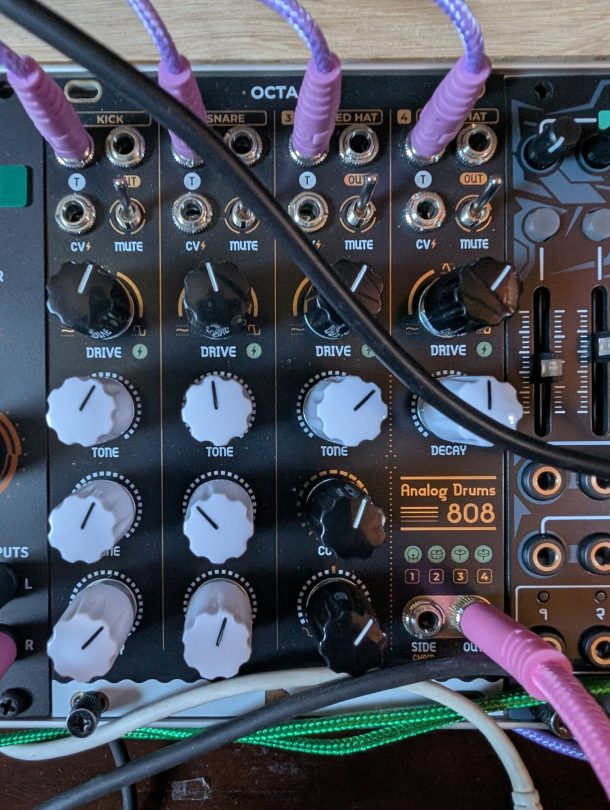
NANO Modules OCTA Eurorack drum module patched in a rack, showing kick, snare and hat voices with drive, tone and decay controls
The OCTA patched up, four voices deep.

The OCTA is a four-voice analog percussion module in 18 HP: kick, snare, and two percussion channels that cover hats and metallic sounds. Where most drum modules give you one voice and expect you to buy three more, the OCTA gives you a complete rhythm section behind a single panel.

Four analog voices

Each channel is a discrete analog voice with its own decay, tuning and character controls, plus a dedicated overdrive stage. The kick has the weight you want without tuning tricks; the snare sits between the 808 and 909 traditions depending on where you set the noise and body balance; the two percussion channels reach from tight closed hats to metallic clangs.

Routing

Every voice has an individual output as well as a summed mix out, which is the routing flexibility that makes the module usable in a real workflow: take the mix when you want speed, split the individual outputs when you want to process the kick separately from the hats.

Power and depth

Here the honest caveat: 40 mm of depth rules out the slimmest skiffs, and the -12 V draw of 115 mA is high for the module’s size. On a generously powered case it is a non-issue. In a power-tight rack it is the number to check before you buy, which is exactly why we publish measured current figures.

Verdict in practice

Sequence it from an external drum sequencer and it locks in immediately. Push the overdrive past three o’clock and the kick develops a genuinely aggressive edge that suits industrial and broken-beat material, and cross-modulating the snare decay from the kick output gives you the movement that makes a pattern feel alive.

Behind the panel are four discrete analog voices sharing one power header. There is no menu layer and no voice sharing: every channel is its own circuit, which is what four voices in 18 HP costs on the negative rail.

  • Per-voice controls for tuning, decay and character, so each channel is set up independently.
  • A dedicated overdrive stage on every voice, which is where the aggression comes from.
  • Individual outputs plus a summed mix bus, so the module can be taken as one rhythm source or split apart and processed channel by channel.
  • Gate inputs per voice, with the kick channel also accepting an accent gate, which is what makes the velocity-style variation in the patch recipe possible.

Patch recipe

Industrial Broken Beat: Patch an accent gate into Ch 1 (Kick), push Ch 1 Overdrive past 3 o'clock, and cross-modulate Ch 2 Snare decay using Ch 1 output.

The Verdict

8.5/10

A cohesive four-part analog percussion voice that excels at immediate, punchy electronic rhythms without requiring four separate modules.

Pros

  • 4 complete analog voices: Kick, Snare, and two Perc/Hats
  • Dedicated overdrive on every channel
  • Individual and mix outputs for flexible routing

Cons

  • 40mm depth requires careful case planning (not ultra-slim skiff friendly)
  • Relatively high -12V current draw (115mA)

Does it stay in my rack?

Stays for now, until something better

OCTA stays in the rack until something better or smaller comes along. It is the drum voice the rack currently relies on and it does that job well, but 40 mm of depth and 115 mA on the negative rail are real commitments. A module covering the same four voices in less depth or with a lighter power draw would displace it — until that exists, it stays.

Why the Maker Matters

The OCTA is the one thing in this rack I would replace with the same thing. It is punchy in the way the drum machines it is chasing are punchy, the four voices sit together as a kit rather than as four unrelated sounds, and it has not given me a reason to take it out since the day it went in.

The pairing that makes it work is the drum sequencer on the BeatStep Pro. That gives eight physical gate outputs, and the OCTA has a trigger input for every voice: patch four of them and the kit is sequenced from outside the rack with no adapter, no MIDI-to-CV conversion and no menu. That is the whole reason it earns its place — it responds like a drum machine because it is being driven like one.

It is also worth knowing who made it. NANO is a small independent outfit in Valencia, working since 2018, and the team designs, tests and builds its products itself — engineering and product design backgrounds, a catalogue that grew patiently rather than arriving all at once. That is the opposite of a badge put on someone else's design. After writing about the Abacus it is the thing I keep coming back to: this is the kind of maker the money is better spent with, even when a module costs more per voice and asks for 40 mm of depth to do it.

So it stays in the rack until something smaller or better turns up, which is a fair description of where it sits rather than a complaint. The depth and the negative-rail draw are real costs and I am not pretending otherwise. But nothing I have found yet fits these four voices into less space, and until something does, I am not looking.

Where to buy

NANO Modules OCTA

€280 / $299

Buy the NANO Modules OCTA

We may earn a small affiliate commission at no extra cost to you.